
Tilburg
Currency
Euro (€)
Language
English, Dutch
Best Time to Visit
April, October
Getting Around
Walk, Bike, Bus
Table of Contents
Things to do?
My Favorites
Top 10 Attractions


2. De Pont Art Gallery
De Pont Art Gallery exhibits modern works by renowned artists. Permanent collections share space with rotating ones throughout the year.

3. TextielMuseum
The Dutch TextielMuseum preserves history and artistry of Dutch textile craft. Nearly 25,000 artifacts trace the industry’s evolution through time.

4. Pieter Vreedeplein
Pieter Vreedeplein counts as Tilburg’s main shopping center. Stores, restaurants and entertainment pack the complex from end to end.

5. De Oude Warande
De Oude Warande translates into Tilburg’s oldest park. Lakes shimmer between trees, plants burst with color and cafes invite you to live longer.

6. Schrobbeler
Schrobbeler brews typical Dutch beer right here in Tilburg. Locals favor this drink at bars scattered throughout the city.

7. Theaters Tilburg
Tilburg Theater holds the title as largest theater in the city. Shows, concerts and events fill the calendar in the course of the year.

8. Cinecitta
Tilburg houses Cinecitta movie theater, where cutting edge technologies project international films across multiple screens.

9. Koningsplein
The Koningsplein Market draws Tilburg shoppers every week. Browse, taste cooked dishes and pick up fresh goods from local vendors.

10. Steam 013 Coffee
Steam 013 Coffee & Cake is exactly what it sounds like, a coffee shop inside a real train coach. The favorite morning caffeine stop among locals.
Top 10 Attractions in Tilburg
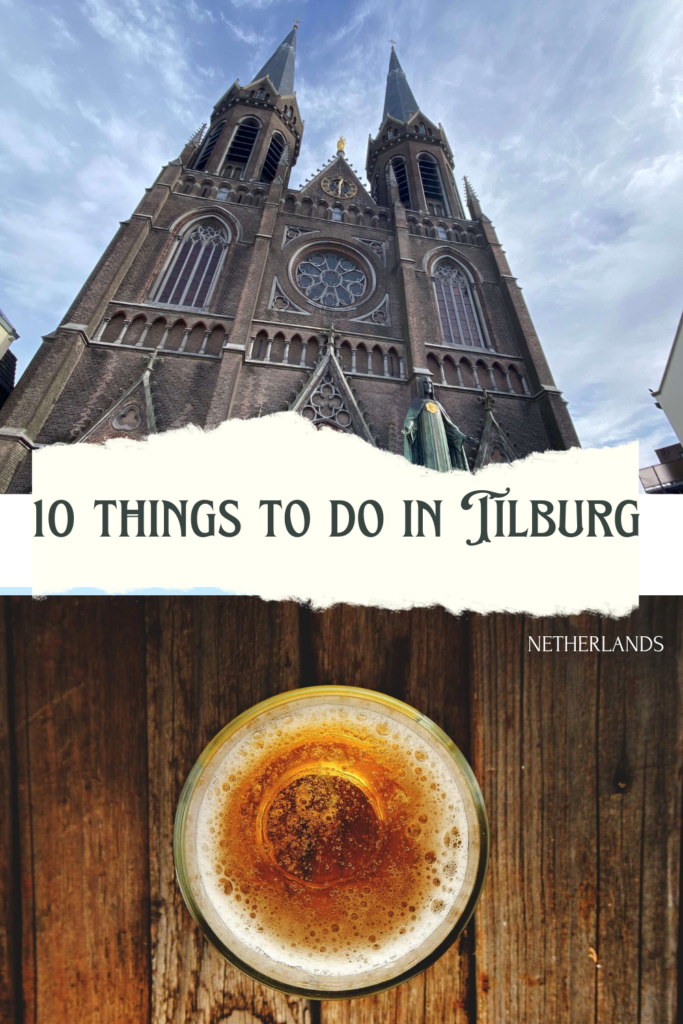
St. Joseph Church
Tilburg's Soaring Symphony of Neo Gothic Beauty
Two neo-Gothic towers rising 72 metres above a busy city square tell you immediately that this church takes itself seriously.
Located along Heuvelring in central Tilburg the Sint-Jozefkerk sits on the edge of the Heuvel square and opens daily from 09:00 to 17:00. Entry is free. Modest dress is expected as this is an active Catholic parish.
Construction unfolded in two phases due to financial constraints with the first section completed between 1871 and 1873 and the towers built in 1887 and 1889. Architect Hendrik van Tulder designed it to serve a population that was expanding fast as Tilburg industrialised. The ground it stands on was previously a military barracks.
Most visitors photograph the facade then leave. A small chapel near the entrance called the Chapel of Perpetual Worship has remained open 24 hours a day since 1991. The intention of always having at least one worshipper present making it one of a handful of places in the Netherlands maintaining this practice. That detail alone changes how you see the building.
Inside the four-part rib vault stretches across the full cruciform basilica and the altarpiece carved by Hendrik van der Geld dates from between 1878 and 1881. Georges de Geetere painted the Stations of the Cross frescos two decades after consecration. A metal grate now separates visitors from the main nave during non-service hours though the entrance chapels remain accessible. The acoustics are exceptional. Stand still for a moment and the organ resonance settles into your chest before you consciously register it.
The church has held rijksmonument status since 1976 protecting both the building and its two organs as national heritage. A 1921 Sacred Heart statue stands in front whose original gold heart was replaced after a theft attempt in 1982.
Worth 30 to 45 minutes. Best for architecture enthusiasts, those interested in active Catholic heritage or anyone needing ten minutes of real quiet in a busy city centre.
De Pont Art Gallery
A Modern Haven for Contemporary Art
One of Europe’s contemporary art museums settles inside a former wool mill in a Dutch city most visitors fly straight past.
De Pont opened in 1992 after architect Benthem Crouwel converted the derelict Thomas de Beer spinning mill into an exhibition space. Find it at Wilhelminapark 1. Admission is free for anyone aged 26 and under and free for all visitors every Thursday evening from 5pm to 8pm. Standard adult tickets apply outside those windows. Plan two and a half hours minimum.
The museum exists because of Jan de Pont, a lawyer who helped rescue the Thomas de Beer mill from bankruptcy in the 1960s and later left a portion of his estate to support contemporary visual art. The building he saved eventually became the museum that bears his name. That circularity gives the place a emotional core most purpose-built institutions simply lack.
Here is what most visitors overlook. De Pont’s founding acquisition policy required that every artwork be made by a living artist, no historical safety net. Every purchase was a bet on someone still working. That discipline produced a collection of real conviction, rather than inherited prestige.
The sawtooth roof floods the grand central hall with northern daylight and the effect on large-scale sculpture is extraordinary. Works by Richard Serra, Anish Kapoor, Marlene Dumas and Bill Viola anchor the permanent collection, while rotating solo exhibitions go deep into a single artist’s output rather than skimming across movements. A 2016 wing added space for photography, video and multimedia, alongside a café connecting to a walled garden planted with apple trees and Japanese wineberry. Sometimes, a museum earns that kind of stillness.
Worth it absolutely. Serious contemporary art lovers should block a full afternoon. Curious visitors with two hours will still leave having seen something that stays with them.
TextielMuseum
A Journey Through Textiles of Time
The only place in the world where textile design, art, fashion, heritage and innovation converge under one roof. Tilburg’s TextielMuseum earns its reputation without needing to oversell itself.
Find it at Goirkestraat 96. Opening hours run Tuesday through Friday from 10:00 to 17:00 and Saturday through Sunday from 12:00 to 17:00. The museum is closed on Mondays. Book e-tickets in advance via the museum website. The Netherlands Museum Pass is accepted and can also be purchased on-site.
The museum opened in 1958 in a former villa connected to a nearby factory before relocating in 1985 into the old premises of C. Mommers & Co., once among Tilburg’s largest industrial employers. A full renovation was completed in 2008. Tilburg built its identity on the wool trade and this building still carries that weight in its bones.
Most visitors walk past the TextielLab’s glass partition without stopping to watch. Don’t. Active projects are developed here daily by designers, artists and architects. You can observe the process directly, a rare, unfiltered view of making.
The collection spans four areas: textile science, design, industrial culture and arts. Temporary exhibitions rotate regularly, placing historical subjects alongside showcases of current textile development. The TextielLab itself demonstrates active weaving, knitting, lasering, tufting and embroidery on machines that feel nothing like relics. In 2017 the museum won the Dutch Museumprijs in the Design and Fashion category and 2023 brought its highest ever annual visitor count at 77,602.
Plan two to two and a half hours. This museum rewards curiosity over speed and suits design professionals, fashion-minded travellers and anyone who wants to understand a city through what it once made.
Pieter Vreedeplein
The Beating Heart of Tilburg
Not every Dutch square earns its place in the streetscape. Until the mid-2000s, Pieter Vreedeplein was nothing more than a large open-air car park sitting at the geographical heart of Tilburg. Prime real estate squandered on tarmac and exhaust fumes.
Where? Centrum district, a ten-minute walk from Tilburg Central Station. Open as a public square at all hours. Shops follow standard Dutch retail hours, with Thursday late-night shopping until 21:00. Sunday opening is standard here, which remains uncommon in the Netherlands.
In 1998, Tilburg City Council partnered with a private developer to transform the esplanade into a mixed-use complex. The finished project, completed in 2009, delivered 125 dwellings, 30,000 square metres of retail space, a seven-screen cinema and a 900-space underground car park. The square is named after Pieter Vreede, an eighteenth-century textile industrialist whose wool factory once anchored this part of the city.
Most visitors walk straight to the shops without reading the ground beneath their feet. Seventeen granite benches are arranged across the square to spell out the letters of Pieter Vreedeplein, a detail almost nobody notices.
The paving uses two-toned granite slabs in alternating light and dark friezes. A slender triangular tower punctuates the skyline above the arcade. The retail mix skews toward Dutch and European chains. Media Markt handles electronics, Zara and The Sting cover mid-range fashion and Men at Work targets menswear. Bershka and Sissy Boy sit nearby for younger shoppers, Sacha covers footwear and a Plus supermarket handles daily groceries. The PlayFountain, installed more recently, covers 100 square metres and runs over 1,000 water jets. In summer, children treat it like a paddling pool, while their parents drink coffee at the surrounding terrace restaurants. Vinyl markets fill the square on rotating monthly dates and winter brings an ice rink and seasonal fairground rides.
Spend an hour here. It serves shoppers, casual walkers and anyone curious about how Dutch cities rebuild from the inside out.
De Oude Warande
A Haven for Nature and Leisure
Eight avenues radiate from a single point, carving a seventy-hectare forest into perfect geometric quarters and almost nobody in the travel world is talking about it.
De Oude Warande lies south of the Tilburg–Breda railway line, between Tilburg University station and the Reeshof district. Entry is free and the park is open year-round. Spring and autumn reward the most visitors. No dress code applies and no ticket booth exists.
In 1712, Willem van Hessen-Kassel obtained permission from local magistrates to convert roughly sixty hectares of common land into a private hunting and pleasure ground, drawing inspiration from the formal baroque garden designs of André Le Nôtre. The architect behind the gardens at Versailles. The community lost that land for almost nothing. Three centuries later they have it back.
Most visitors simply walk the shaded lanes and miss what is directly beneath their feet. A Tilburg zoo once occupied part of this ground between 1932 and 1973. When it closed, its Siberian ground squirrels escaped into the forest. Their descendants still live here. You will not find that on any signpost.
Stand at that centre point and the geometry becomes immediate. Callum Morton’s Grotto Pavilion houses here, a mirrored glass structure designed to be nearly invisible, functioning simultaneously as artwork and a café open April through November.
The Lustwarande Foundation has used the park as a platform for contemporary sculpture since 2000, adding rotating works that sit in unexpected clearings throughout the woodland.
Plan ninety minutes at an easy pace, longer if the Grotto is open. This is for walkers who want structure in their nature, literally.
Schrobbeler
Tilburg's Secret Elixir (with a Kick!)
Schrobbeler a Dutch herbal liqueur born 1973 in Tilburg and it tells you more about this city than any museum pamphlet will. Find the distillery on an industrial estate in the south of the Netherlands, about fifteen minutes on foot from Tilburg Centraal. Tours run every Saturday and Sunday and must be booked in advance through the official website. Entry covers three hours of guided experience including tastings, a quiz and live music.
Jan Wassing, a local entrepreneur with a troubled stomach, began blending his own remedy for Carnival and serving it to friends from his home bar, which he called “Bij den Schrobbelaar”. The name referred to the wool carder, a textile worker central to Tilburg’s industrial past. When Jan died in 1981, his son Pieter-Jan kept the recipe alive and took the liqueur into proper production. The family still runs the operation today.
Schrobbeler is sold in stone bottles because Tilburg’s wool workers once carried stone jugs to collect urine, which was used as a scouring solvent for sheared wool. The bottle is not a gimmick. It’s a quiet historical argument.
The liqueur contains 43 different herbs, though the precise blend remains a family secret. Recognizable notes include star anise, cinnamon and cloves. Surprisingly, garlic, which is undetectable but enhances the other flavors. Served over ice with a slice of lime, it is sharp, warming and peculiar. The ANWB, the Dutch touring association, voted this tour the best day out in North Brabant.
Three hours here rewards any curious traveler. Best suited to those who like their sightseeing with something to drink at the end of it.
Theaters Tilburg
From Post Office to Performing Arts Palace
Tilburg’s cultural address packs a concert hall, a theatre, a studio and an arthouse cinema into one national monument. The fact alone separates it from the average regional venue.
The complex sits on Louis Bouwmeesterplein in the city centre, roughly a fifteen-minute walk from Tilburg Centraal station, with buses 1 and 2 stopping at Stadhuisplein nearby. Tickets vary by production and can be booked at theaterstilburg.nl. The box office and on-site restaurant Lucebert open daily, noon to 1am on weekdays and 11am on weekends. No dress code applies beyond what the evening itself calls for.
The original plans for the theatre date back to 1910 but stalled for decades due to funding. A textile factory filled the gap from 1928. The current Schouwburg finally opened in 1961, designed by architects Bernard Bijvoet and Gerard Holt. In 2015 the building received rijksmonument status, the Dutch equivalent of a listed national heritage designation.
Most visitors walk straight to their seats. The sharper ones pause in the foyer of the Concertzaal to study the light installation by Dutch artist Peter Struycken, which shifts through colour as the evening progresses and is unlike anything in a comparably sized Dutch venue.
The programme runs to more than 300 performances and concerts per year alongside roughly 600 film screenings. Genres span music, cabaret, modern dance and street dance. The main hall holds 900 seats, while a smaller auditorium accommodates around 180. Several major Dutch musicals have premiered here. That tells you something about how Tilburg residents feel about this place.
Spend an evening rather than just attending a single show. Arrive early, eat at Lucebert and let the building work on you, before the curtain rises.
Essential for any visitor with even a passing interest in theatre, music or Dutch cultural life.
Cinecitta
Where Classic Meets Modern on the Silver Screen
Cinecitta, the oldest continuously operating cinema hall in the Netherlands, housed inside a protected national monument in the heart of Tilburg.
Find it at Willem II Straat 29, a short walk from Tilburg Centraal station. The venue runs screenings throughout the week, check cinecitta.nl for schedules. Standard tickets are modestly priced and Cineville pass holders enter free.
Films have been shown on this site since 1904, when traveling companies screened shorts in the concert hall of the Souvenir des Montagnards. A permanent cinema opened here on 13 October 1916 under the name De Nieuwe Bioscoop, later cycling through identities as Cinema Royal, Camera and Ambassade before becoming Cinecitta in 1983. A major restoration followed in 2012, earning the building second place in the NRP Gulden Feniks restoration prize, behind only the Mauritshuis.
Cinecitta receives no structural government subsidy, it survives entirely on ticket sales, sponsorship and donations. Such independence quietly shapes every programming decision made here.
The venue now holds three main cinema screens, a multifunctional hall, a meeting room, a restaurant and a bar. Two additional underground screening rooms and a glass atrium were added at the end of 2020. The underground halls feel theatrical, low ceilings, warm acoustics and sight lines so clean that no seat feels secondary. Beyond regular screenings, Cinecitta hosts international film festivals, film courses, lectures and musical evenings, functioning as a full cultural institution rather than a passive venue.
Cinecitta rewards anyone who finds mainstream cinema exhausting. Budget ninety minutes for the film plus time to eat at the in-house restaurant. It suits solo travelers, couples and serious cinephiles equally well.
Koningsplein
Bargains, Bites and Fries
Saturday morning, Koningsplein smells like roasted pistachios and old regret. One comes from the market that fills it twice a week. The other comes from the mayor who demolished an entire neighborhood to build it.
The square sits in the Centrum district, a short walk from Tilburg’s main train station. Entry is free. The market runs every Friday from 9am to noon and Saturday from 10am to 16:30pm. Saturday is the main event. Arrive between 10am and noon to catch full stalls and the best selection.
Here is what most people walking across the square’s open pavement never stop to consider. The ground beneath it once held an entire neighborhood. The Koningswei area, meaning King’s Meadows was demolished and replaced by Koningsplein during a period of aggressive urban renewal driven by Mayor Cees Becht in the 1960s. The redevelopment was widely criticized and many feel the square still carries a certain emptiness on non-market days. The tension between ambition and atmosphere is part of what makes it worth understanding.
Saturday transforms the square entirely. Dozens of stalls fill the space with organic vegetables, fruit, regional specialties, farmhouse goods, handmade crafts, textiles and clothing. French dried sausages, aged cheeses and fish appear regularly. This is not a tourist market dressed up for cameras. A vendor selling roasted pistachios near the center draws a loyal local crowd every week. Watch how Tilburg residents shop, purposefully, slowly, stopping to argue affectionately over whether the strawberries are ripe. The small theatre is the actual draw. Underground parking sits directly beneath the square, which makes the logistics straightforward.
On non-market days Koningsplein is quieter and frankly less compelling. Come on Saturday. Budget 45 to 90 minutes. This is the right stop for anyone who wants to understand how Tilburg actually functions as a working city rather than a visitor destination.
Steam 013 Coffee
A Sanctuary for Caffeine and Comfort
The best cup of coffee in Tilburg is served out of a wagon that hasn’t moved in years.
You’ll find it at Burgemeester Brokxlaan 6, a short walk from Tilburg Centraal near the old rail district. The café opens from 8.30am and draws both locals and the occasional confused tourist who stumbles in from the skate park next door. Entry is free. Prices sit comfortably in the affordable range for the Netherlands.
The wagon rests diagonally behind the central city, radiating the energy of a diner-in-the-middle-of-nowhere that you’d normally only find in a film. Tilburg’s Spoorzone district has been transforming its industrial rail heritage into cultural space for years. Steam 013 belongs to that same spirit, small, deliberate, unpolished in the best way.
The kitchen rotates its focus, brownies and poppy seed cake anchor the counter, none of it over sweetened and all of it baked to complement rather than compete with the coffee.
Beans are sourced from Boca AMS, an Amsterdam specialty roaster with reputation. The latte art is precise, the cakes land somewhere between comfort and craft. The tea arrives in a brewer that regulars describe as unlike anything they’ve tasted elsewhere. Seating is limited inside the wagon, plan accordingly or arrive early and claim your spot before someone else does.
Worth an hour of any itinerary. Solo travelers and pairs and anyone who values craft over convenience.
Conclusion
FAQs
How to Get to Tilburg
How to Travel to Tilburg From Major Cities
Here’s an outline from key locations:
Rotterdam
- Car: Enjoy a scenic drive of approximately 1 hour via A15 highway.
- Train: Direct trains from Rotterdam Centraal Station take around 1 hour.
- Bus: Regular bus services take 1 hour and 30 minutes.
Amsterdam
- Car: A short 1 hour drive via A2 highway.
- Train: Direct trains from Amsterdam Centraal Station take around 1 hour.
- Bus: Quick bus connections with a travel time of 1 hour and 30 minutes.
Brussels
- Car: Take in the scenery with a 2 hour drive via A13 highway.
- Train: Direct trains from Brussels Midi Station take 2 hours.
- Bus: Comfortable buses connect Brussels and Tilburg in around 3 hours.
Parking in Tilburg
- Street Parking: Tilburg offers limited on street parking.
- Public Parking Lots: The city provides public parking typically in central areas.
- Hotels w/ Parking: Many hotels in Tilburg offer on site parking facilities.
Airport Access in Tilburg
- Location: Situated 45 km southeast of Tilburg.
- Transportation: Taxis, shuttle services and buses are available for a quick transfer.
- Car Rental: Several reputable car rental agencies operate at Eindhoven Airport.
Ground Transportation in Tilburg
Cars, buses and trains, the triumphant trio of travel. Providing a variety of choices:
Best Resources for Travel Planning

Flights
- Skyscanner
- Kayak
- Momondo
Accommodation
- Booking
- Agoda
- Hostelworld
- Airbnb
- +More
Transport
- Rental Cars
- Flixbus
- Trainline
- Interrail Pass
- + More
Tickets
- Viator
- Get your Guide
- Tripadviosor
Travel Finance
- Wise
- Revolut
Credit Cards
- American Express Gold Card
- Citi Premier Card
Travel Insurance
- Safety Wing
- Insure My Trip
- Medj
VPN
- Surfshark
- NordVPN
Flights
For seamless travel, meet your flight-booking wizards.
- Skyscanner: The Swiss Army knife, budget-wise, with a user-friendly interface.
- Kayak: Your travel detective, comparing deals across platforms, explore feature.
- Momondo: The local friend, uncovering affordable flights, for unique itineraries.
Accomandation
Choosing accommodation is like selecting a travel companion—it shapes your journey.
- Booking: Cozy guesthouses to luxury hotels, user-friendly and easy booking.
- Agoda: Unveiling unique accommodations, perks through a loyalty program.
- Hostelworld: The budget explorer’s compass, guiding to affordable stays.
- Airbnb: The disruptor, your local friend guiding you to unique spots.
- Secret Escapes: Offers exclusive deals on luxury accommodations worldwide.
- HostelPass: Discounts and perks for budget travelers staying in hostels.
- Plum Guide: Curates a collection of high-quality vacation rentals vetted by experts.
Transport
Discover Cars, Buses, and Trains for a journey as memorable as your destination.
- Rental Cars: Freedom on wheels, from compacts to SUVs, explore at your pace.
- Flixbus: Budget-friendly bus journeys across Europe for city-hopping.
- Trainline: Swift and easy track navigation with a one-stop ticket booking.
- Interrail Pass: Unleash European train travel magic, exploring diverse cultures.
- Eurail Pass: Extensive rail travel across Europe’s diverse landscapes.
- Rom2Rio: Simplifies travel planning by comprehensive route options.
- Outdoorsy: Connects nature enthusiasts with distinctive outdoor Rental.
- RV Share: Enables travelers on road trips through peer-to-peer RV rentals.
Tickets
Online ticketing platforms have revolutionized travel and entertainment experiences.
- GetYourGuide: Turns ordinary trips into immersive adventures, local guides.
- Viator: Simplifies your travel experience, offering a seamless platform for tours.
- Tripadvisor: Your guide to travel reviews and recommendations.
Travel Finance
Simplifying transactions and currency exchange for a smooth travel money experience.
- Wise: Formerly TransferWise, empowers travelers with real mid-market rates.
- Revolut: Fintech trailblazer, an app, currency wallet and fee-free spending abroad.
Credit Cards
Credit cards offer benefits like rewards and are useful for easy transactions or purchases.
- American Express Gold Card: Dive into a world of privileges and points.
- Citi Premier Card: A blend of rewarding points and flexible redemption options.
Travel Insurance
Providing comprehensive coverage and protection for travelers globally.
- Safety Wing: Excels in flexibility, providing coverage for digital nomads.
- Insure My Trip’s: Extensive network facilitates easy comparison.
- Medjet: Emergency transport, ensuring rapid air medical transport.
VPN
Encrypting your connection, hides your IP address, and defense against cyber threats.
- Surfshark: User-friendly features, unlimited device connections, secure.
- NordVPN: Vast server network, high speed connections and safe online presence.